
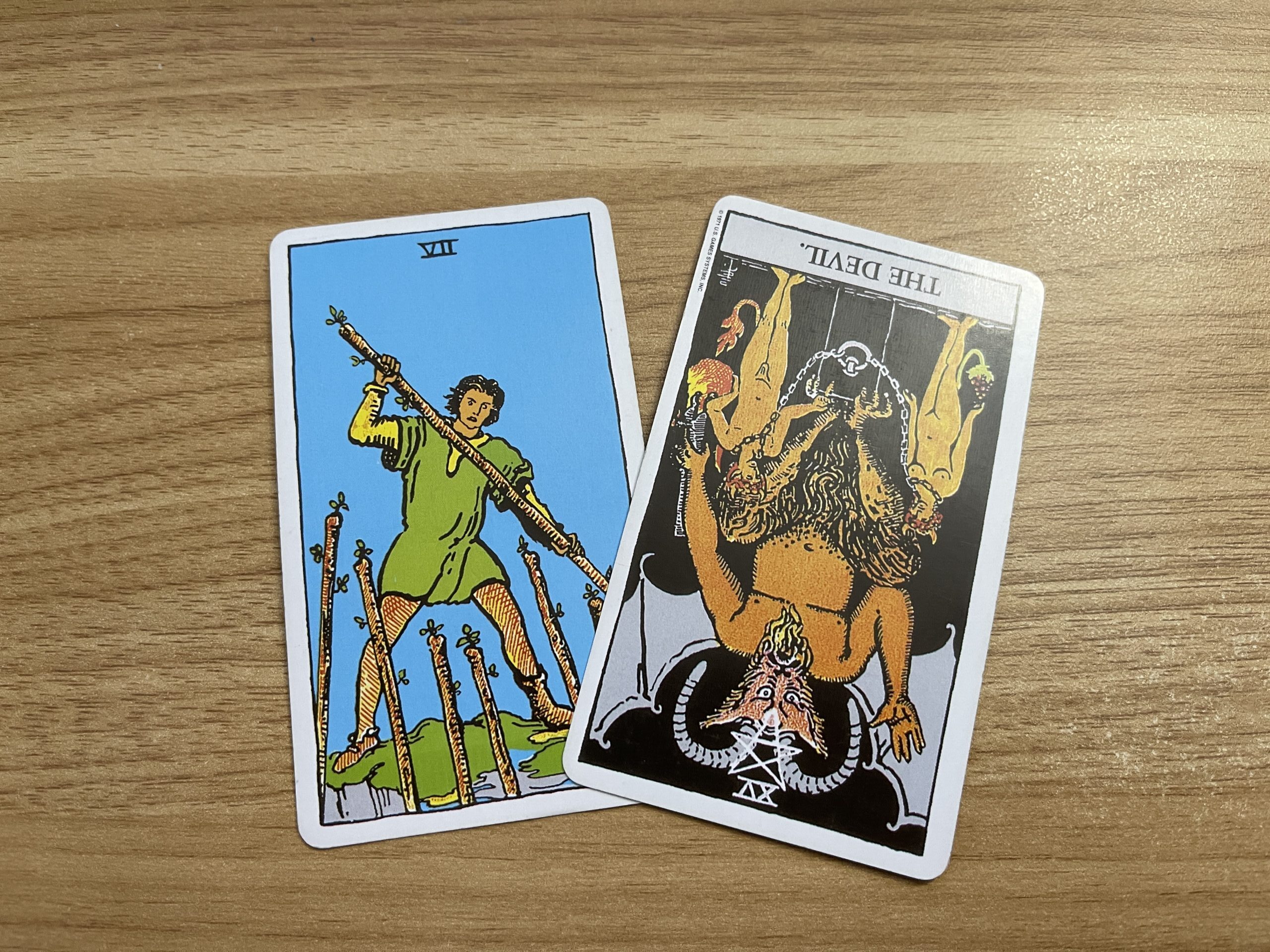
I am the primary caregiver for my mother-in-law, who has dementia. That sentence sounds simple until you are living it. Caregiving has a way of taking over the landscape of your life. There is always something to anticipate, something to manage, something to remember, something to watch, or something to figure out. Even when nothing is actively going wrong, part of you is waiting for the next thing.
Yesterday, I asked my tarot cards a simple question: “What am I missing?”
What the Cards Reminded Me
I pulled the Seven of Wands. If I had reached immediately for the book, I would have found the usual meanings: standing your ground, defending your position, perseverance, challenge, and continuing despite opposition. All of those meanings made sense. My life is demanding right now, and perseverance has become something of a daily practice.
But that wasn’t what I heard.
My immediate thought was, “I am forgetting that this is hard.” Somewhere along the way, I had stopped giving myself permission to acknowledge that. I have become so accustomed to solving the next problem and managing the next thing that difficulty has started to feel like the normal state of my life.
Seven of Wands
The Seven of Wands reminded me that it isn’t. This is a hard season. It is not my entire life, and it is not necessarily what my life will look like next year or five years from now. It is a season I am living through, and I can acknowledge how difficult it is without deciding that I will always be here.
Most importantly, I felt this: “I will be okay.” That wasn’t written in the little book that came with my deck. Today, I asked the same question again: “What am I missing?”
Devil Reversed
This time, I pulled the Devil reversed. Again, I could have reached for the book. The reversed Devil can speak of breaking free, releasing attachments, recognizing unhealthy patterns, and reclaiming your power. Those meanings are all there.
But once again, my first response was different. I felt that I am not tied to this reality in the way I sometimes believe I am. The circumstances of my life are real. Caregiving is difficult. Dementia is difficult. Exhaustion is real. There are things I cannot control, and some days ask more of me than I think I have to give.
But there is another layer I can control. I can decide how much of the negativity I continue to carry after the moment has passed. I can notice when my mind starts telling me that this is forever. I can recognize when one difficult day becomes evidence that my entire life is difficult.
The Devil reversed felt like a reminder to let some of that go. I don’t need to let go of the caregiving, the responsibilities, or the reality of what is happening. What I can release is the extra suffering I sometimes attach to it.
And suddenly, the two cards seemed to be speaking to each other. The Seven of Wands said, “Stop minimizing how hard this is.” The Devil reversed said, “But stop magnifying it, too.”
From Knowing the Meaning to Hearing the Message
That is where tarot gets interesting for me. There is a difference between knowing what a card means and knowing what a card is saying to you.
When we first learn tarot, we need the books. We need the traditional meanings. There is a time we need to learn the structure of the deck and understand the symbolism. We need somewhere to begin. There is nothing wrong with looking up the Seven of Wands or checking what the Devil reversed traditionally represents. Those meanings give us a foundation and a language for understanding the cards.
But eventually, something changes. We stop asking, “What does this card mean?” We begin asking, “What does this card mean here?”
That distinction matters. The traditional meaning gives you the landscape. Your intuition tells you where you are standing in it.
My Seven of Wands did not contradict its traditional meaning. Instead, it gave me a very personal expression of it. I am persevering, standing my ground, and dealing with challenge. What I needed to hear, though, was that I was allowed to admit how hard it has become.
The Devil reversed offered another personal expression of its traditional meaning. I heard freedom as the possibility of releasing my attachment to the idea that my current circumstances define my entire reality. The caregiving is real, but it does not have to define everything I think, feel, or believe about my life.
I wasn’t making up a meaning because I wanted a particular answer. I was paying attention to what the card brought up in me. That response became part of the reading.
What We Miss
That is the part I think we sometimes miss when we are learning tarot. We can become so concerned with getting the interpretation “right” that we forget to notice what happened inside us when we first saw the card. We pull a card, something immediately comes to mind, and then we reach for the book. Suddenly, we are wondering whether our first thought was wrong.
Maybe it wasn’t. Maybe that first thought was the beginning of the reading. Trusting yourself with tarot doesn’t mean throwing away the books or deciding that every card can mean anything you want. It means allowing what you have learned to become a foundation rather than a set of rules. You learn the vocabulary, the archetypes, and the symbolism. Then you begin having a conversation.
A card may reveal something you never considered, confirm something you already knew, or remind you of something you had forgotten. That is exactly what happened to me over these two days.
I asked, “What am I missing?” The answer wasn’t hiding in the book. It was in my first response to the card.
Perhaps that is one of the biggest shifts we make as tarot readers: realizing that we don’t always need someone else to tell us what the card means. Sometimes, we already heard it. We just need to trust ourselves enough to listen.
