
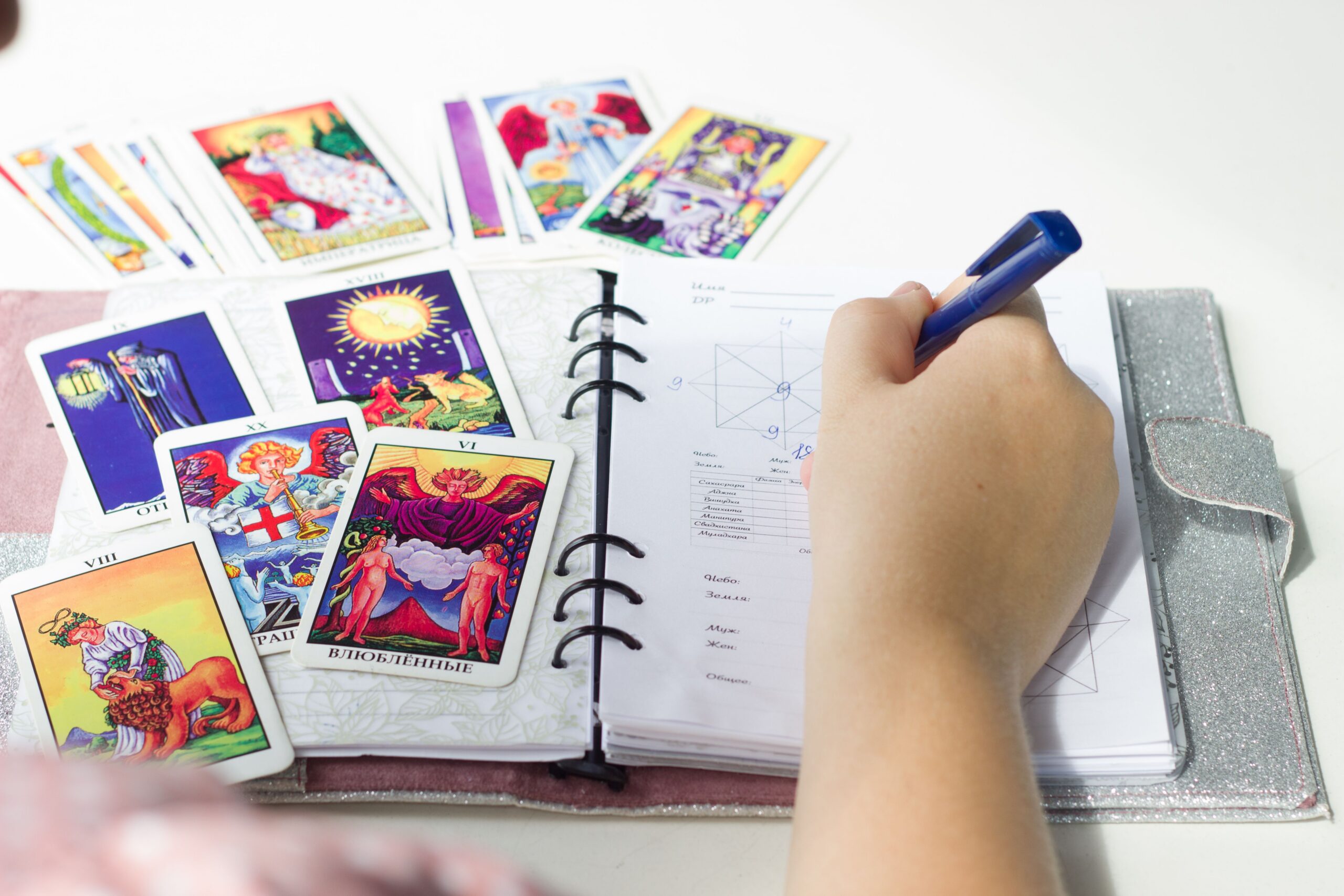

Many people think a tarot reading ends when the cards are put away. In reality, that is often where the most meaningful work begins.
Tarot and journaling create a powerful partnership because they encourage you to slow down, reflect, and notice patterns that might otherwise go unnoticed. A reading may offer insight in the moment, but writing helps you understand how that message unfolds over time.
I often encourage my students to keep a tarot journal, not because there is a right or wrong interpretation, but because their own experiences become their greatest teacher. The cards may stay the same, yet their understanding continues to grow with every entry they write.
Why Tarot and Journaling Work So Well Together
A journal allows you to capture your first impressions before doubt has a chance to rewrite them. You can record the cards you pulled, the emotions you felt, the symbols that stood out, and the questions that surfaced during your reading.
As the weeks and months pass, those notes become more valuable than you might expect. You begin to recognize recurring themes, repeated cards, and life lessons that continue to appear. You also discover how your relationship with the cards evolves as your confidence grows.
Many students are surprised when they look back at older journal entries. The message they struggled to understand often becomes perfectly clear with the benefit of hindsight. What once seemed confusing suddenly makes sense because life has provided the missing context.
A tarot journal is not simply a record of readings. It is a record of your personal growth.
Discover the Story You Are Living
One of the greatest benefits of tarot and journaling is that they shift your focus away from predicting the future and toward understanding yourself. Instead of asking, “What will happen?” you begin asking, “What am I learning?” That simple change transforms tarot into a tool for self-discovery rather than a search for certainty.
Your journal also reminds you how far you have come. It captures moments of uncertainty, personal breakthroughs, and lessons you might otherwise forget. Over time, you begin to trust both your intuition and your ability to interpret the cards through your own lived experience.
You do not need to write pages after every reading. A few thoughtful observations can reveal more than you realize. The important part is creating a habit that allows you to reflect instead of rushing to the next question.
If you want to deepen your tarot practice, start with a notebook and an open mind. **Tarot and journaling** are not about finding perfect answers. They are about discovering yourself, one reading and one written reflection at a time.



Learn Tarot with Colleen
Join our Tarot Community for practice and connection.
Leave a Reply