
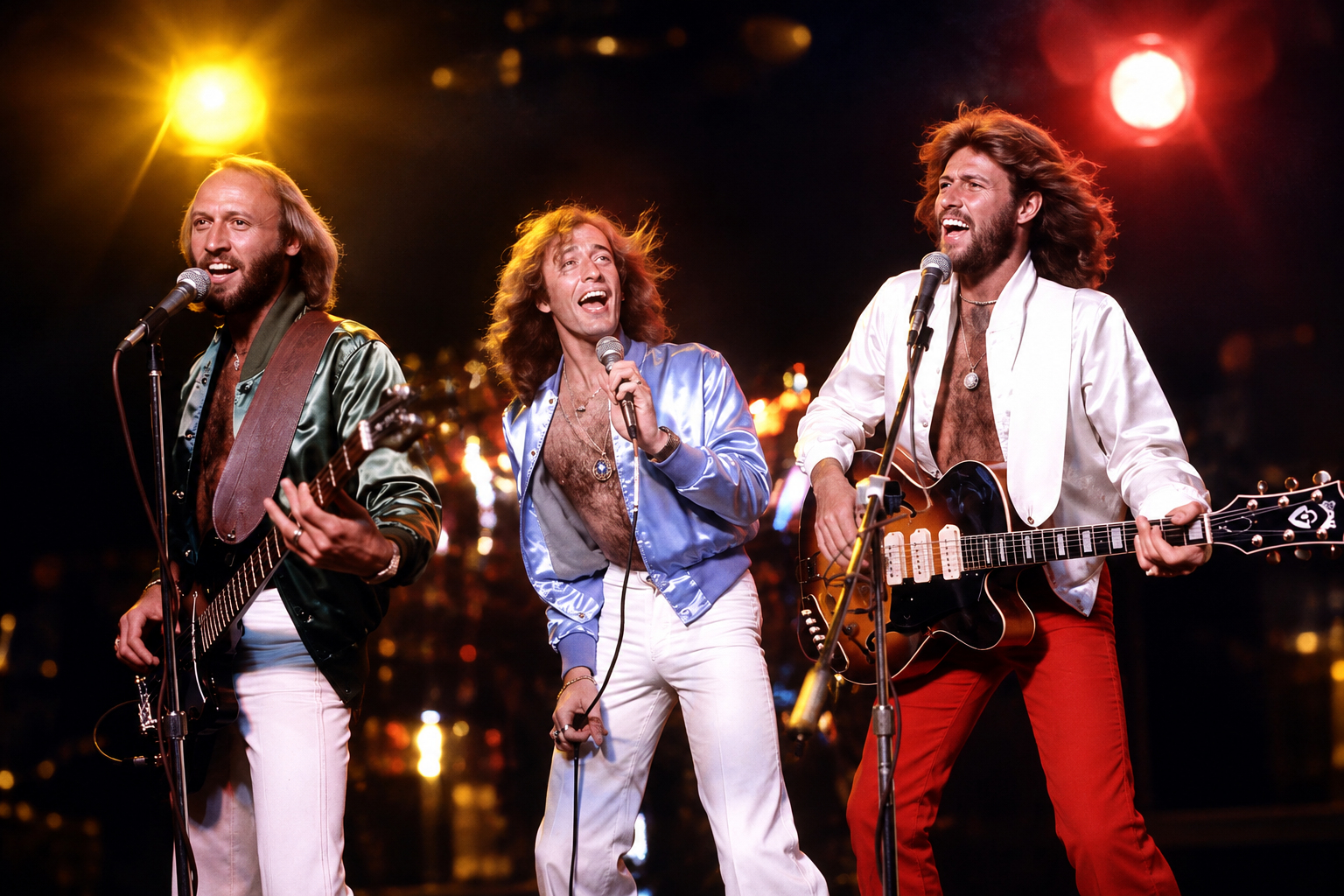
There are artists whose music I enjoy. Then there are artists whose music follows me through different parts of my life. The Bee Gees are one of those artists for me. Their music covers far more ground than the disco era that made them famous. They wrote tender ballads, emotional love songs, pop, R&B, and music that still fills a dance floor. Their harmonies became part of their signature, but their catalog reveals something deeper. They understood emotion.
That is what I hear when I listen to them through Tarot. Their songs move through longing, desire, heartbreak, devotion, belonging, survival, and joy. Those are not just musical subjects to me. They are archetypal experiences, and Tarot gives me a language for recognizing them.
The King of Cups
If I had to choose one Artist Card for the Bee Gees, I would choose the King of Cups. He understands emotion without being consumed by it. He can feel deeply while still finding a way to contain, shape, and express those feelings. That quality runs through so much of the Bee Gees’ music.
Their songs can be heartbreaking without becoming chaotic. They can express longing, grief, desire, devotion, loneliness, and joy while remaining musically controlled. Their harmonies almost reinforce that idea. There is emotion everywhere, but there is structure holding it together.
I also hear The Magician in the Bee Gees. The Magician represents their ability to transform what they had into something new. They moved through different musical eras without losing their identity, and their catalog shows an extraordinary ability to adapt without becoming unrecognizable.
For me, though, the distinction matters. The Magician is how the Bee Gees create. The King of Cups is what they know how to hold. That combination gives me a very different way of hearing their catalog.
“Massachusetts” — Six of Cups
“Massachusetts” just feels right to me. I hear the Six of Cups almost immediately. The song carries the feeling of looking backward toward something familiar. It is about leaving, searching for something better, and discovering that distance can change how we understand home.
The interesting part is that the Bee Gees had never actually been to Massachusetts when they wrote it. The song came from imagination rather than personal experience. That almost makes the Six of Cups more interesting to me because we can feel nostalgia for places we barely know. Sometimes we are homesick for an idea rather than an actual location.
That is what I hear in “Massachusetts.” The Six of Cups is not simply about remembering the past. It can also represent the emotional pull of belonging and the things that continue to feel familiar after everything else has changed. The song makes that longing audible.
“To Love Somebody” — The Lovers
“To Love Somebody” gives me The Lovers. Not because it is simply a love song, because plenty of songs are love songs without carrying The Lovers. This one feels like a recognition of how profoundly another person can matter.
The Lovers is about connection, choice, vulnerability, and allowing another person to matter. It is not always comfortable. Love asks something of us, and the Bee Gees understood that complexity.
Their music rarely treats love as a simple emotion. Love can bring longing, uncertainty, loss, devotion, and transformation. That complexity is exactly why I hear The Lovers here.
“I Started a Joke” — The Hanged Man
“I Started a Joke” gives me The Hanged Man because the song feels like a story about perspective changing in a way the narrator cannot control. The Hanged Man asks us to look at something differently. Sometimes that shift comes willingly, but sometimes life turns us upside down and gives us no choice.
There is also a strange distance in the song. The narrator seems to recognize his own role in what has happened, but recognition does not immediately provide resolution. That feels very Hanged Man to me because sometimes we understand something only after we stop trying to understand it from the same position.
“How Can You Mend a Broken Heart” — Three of Swords and King of Cups
This is where the King of Cups becomes especially obvious to me. “How Can You Mend a Broken Heart” carries the Three of Swords because the heartbreak is direct. Something has been lost, and the pain cannot simply be wished away.
Yet the song does not feel emotionally reckless. That is where I hear the King of Cups. The feeling is enormous, but it is contained.
The King of Cups does not deny heartbreak. He knows how to sit with it. He understands that feeling something deeply does not require being destroyed by it.
That distinction matters to me. Sometimes emotional maturity does not mean hurting less. It means learning how to hold what hurts.
“How Deep Is Your Love” — Two of Cups and King of Cups
“How Deep Is Your Love” brings me to the Two of Cups. There is mutuality here, with two people recognizing the connection between them and asking whether that connection can be trusted. I hear the King of Cups again because the song is emotionally open without becoming emotionally chaotic.
There is tenderness in it, but there is vulnerability too. The Two of Cups asks whether two people can meet each other honestly. The King of Cups asks whether they can hold what happens when they do.
Together, those cards create something much deeper than romance. They create emotional intimacy.
“Wedding Day” — Ten of Cups
“Wedding Day” has a very personal connection for me. George and I included it in our wedding soundtrack, which makes the Ten of Cups almost impossible for me to ignore. The Ten of Cups is emotional fulfillment made real. It is love becoming a shared life, with family, belonging, home, and commitment woven into the experience.
That is what I hear in this song. If I want to look beneath the Ten of Cups, I also hear The Emperor and The Empress. The Emperor brings structure, commitment, and the decision to build something lasting, while The Empress brings creation, nurturing, abundance, and life.
Together, they create more than a wedding. They create a life. That is why “Wedding Day” belongs in this collection for me. It is not simply a song about marriage. It carries the feeling of choosing to build a life with someone.
“I’ve Gotta Get a Message to You” — Eight of Wands and Judgment
“I’ve Gotta Get a Message to You” takes the Bee Gees somewhere much darker. The song centers on a prisoner awaiting execution who wants a final message delivered to his wife. I hear the Eight of Wands first because there is urgency everywhere. Something needs to be said, and there may not be much time left to say it.
Then comes Judgment. Judgment asks us to face consequences, endings, truth, and what remains when everything else falls away. The song brings those ideas together in a particularly powerful way because a message becomes more important when time is running out.
Sometimes Judgment is not about punishment. Sometimes it is about finally saying what matters.
“Stayin’ Alive” — Strength
“Stayin’ Alive” gives me Strength, not because the song is quiet or gentle. It isn’t. Strength is often misunderstood as force, but the card speaks more strongly to endurance, self-control, courage, and the ability to keep going.
That is exactly what I hear here. The narrator is moving through a world that demands something from him. He has to keep himself together and keep moving. That is Strength without the softness being removed.
Sometimes strength looks graceful. Sometimes it looks like surviving the night.
“Night Fever” — The Devil
“Night Fever” is The Devil. This one feels almost effortless because The Devil represents desire, attraction, pleasure, temptation, attachment, and the things that can become intoxicating. “Night Fever” is built around that energy.
There is movement, sensuality, excitement, and surrender to the moment. The Devil is not automatically evil, which is one of the reasons I enjoy working with this card. Sometimes The Devil simply asks what has a hold on us. Sometimes it asks whether we are enjoying something or whether something is controlling us.
“Night Fever” does not need to answer that question. It simply lets us dance with it.
“Tragedy” — The Tower and Strength
“Tragedy” has a very specific memory attached to it for me. I used to sing it when my son threw a temper tantrum because he didn’t get his way. The Bee Gees were singing about romantic devastation, while I was providing the soundtrack to a child experiencing what appeared to be the greatest catastrophe imaginable.
And yet, the joke works because The Tower is actually present in both situations. The song describes the collapse of something emotionally important. The narrator cannot understand how everything went so wrong. His world has been disrupted, and he is struggling to make sense of it.
That is The Tower.
The difference was scale. My son’s world had not actually collapsed. He simply hadn’t gotten what he wanted. That is where I hear Strength.
Strength doesn’t mean stopping someone else’s emotional reaction. It means remaining grounded while someone else is overwhelmed. Instead of getting pulled into the tantrum, I could step back and recognize what was happening. Sometimes humor helped me do that.
So “Tragedy” became more than a Bee Gees song for me. It became a way of putting an appropriate soundtrack on an inappropriate level of emotional catastrophe. The song itself gives me The Tower. My memory of singing it gives me Strength.
Together, they remind me that perspective can change the way we experience an archetype. The world may feel like it is ending. Sometimes it is only Tuesday.
“Words” — Page of Swords
“Words” gives me the Page of Swords. The Page is curious and wants to understand. He is alert to what is being said and what remains unsaid, which makes this song interesting through a Tarot lens.
Words can communicate love, but they can also complicate it. Sometimes we say too much, sometimes we say too little, and sometimes the words we choose cannot carry everything we actually feel. The Page of Swords understands the power of language, but he also understands that words are never completely neutral.
They can reveal us. They can protect us. They can wound us. Sometimes they simply aren’t enough.
“This Is Where I Came In” — Judgment, Six of Cups, and The World
“This Is Where I Came In” is another favorite of mine, and it feels like a perfect Tarot song. I hear Judgment first because there is recognition here. Something is being understood differently because the journey has changed the person making the return.
Then I hear the Six of Cups. There is something familiar waiting at the other end of the journey. The past has not disappeared. It has become part of the person returning to it.
Finally, I hear The World. The World represents completion, integration, and coming full circle. That makes the title especially powerful to me.
“This is where I came in” is not necessarily a statement about going backward. Sometimes returning to where we started shows us how far we have traveled. We can come full circle without being the same person who began the journey.
One Artist, Many Cards
What I love about working with an artist this way is that I don’t have to choose one card and stop there. The Bee Gees can be the King of Cups, and they can also be The Magician. Their songs can move through The Lovers, The Hanged Man, The Tower, Strength, The Devil, Judgment, and The World.
That does not make the original Artist Card wrong. It makes the artist human. No artist contains only one archetype, and no person does either.
We move through different energies depending on our circumstances. Sometimes we are the King of Cups. Sometimes we are The Tower. Sometimes we are both on the same day.
The Card Does Not Have to Mean Only One Thing
That may be one of the most important things this series demonstrates. Tarot does not belong exclusively to the meanings printed in a guidebook. Those meanings give us a foundation, but our experiences can shape how a card speaks to us.
I am doing that here with music. I hear a song when I see a card, and the song becomes another way of understanding the archetype. Someone else might see the same card and think of a person, a memory, a place, or a moment in their own life.
None of those interpretations has to cancel out the others. The card has room for all of them.
That is part of the beauty of Tarot. We are not always looking for the one correct answer. Sometimes we are discovering what the card means here, now, and to us.
The Bee Gees simply give me another way to hear it.
Hearing the Cards
That is ultimately what this series is about for me. I don’t always look at a Tarot card and think about its traditional definition. Sometimes I hear something. A song appears in my mind, and suddenly the card has a voice.
The Bee Gees remind me how much emotional range Tarot can hold. The King of Cups can break your heart without losing himself in the pain. The Six of Cups can make you homesick for somewhere you’ve never been. The Tower can describe a heartbreak or a child’s Tuesday afternoon.
The meaning can shift without becoming meaningless.
That is what keeps Tarot alive for me. The cards give us a language, but our lives give that language context. Sometimes the best way to understand a card is not to look harder at the card.
Sometimes we need to listen.
And sometimes, the cards sing.
You can find other Singers/Songwriters in this Series here.

You Were Guided Here for a Reason
Work With Colleen Irwin
Whether you are seeking clarity, validation, healing, or deeper spiritual growth, I offer readings, mentoring, and transformative experiences designed to help you move forward with confidence. Explore private sessions, upcoming classes, and events created to support your journey.
Learn Tarot with Colleen
Join our Tarot Community for practice and connection.

Leave a Reply